Q: First off, what the hell is a “kaiju”?
A: Kaiju is a Japanese word meaning, literally, “strange beast.” In the strictest of senses, a kaiju is a giant monster of Japanese origin - Godzilla, Gamera, Mothra, and the like. However, thanks in large part to Guillermo del Toro’s Pacific Rim (2013), the term has in recent years come to more broadly denote any fictional beast of unusual size, regardless of nationality.
Q: So, like, King Kong counts as a kaiju?
A: Kind of! He’s thrown down with Godzilla a few times. I’d say in those cases, yes. The other movies where he’s smaller and fighting normal-sized dinosaurs are up for debate.
Q: But what about dinosaurs? Are they kaiju?
A: Nah. I mean…sometimes? Look, some of the Godzilla kaiju are dinosaurs; Godzilla himself is even technically a dinosaur. But those guys are all fairly stylized and also way bigger than your average joe dino. “Realistic” dinosaurs as would be found in a Jurassic Park movie are firmly out.
Q: And who made you the arbiter of such matters?
A: Literally nobody. This is all my opinion.
Q: Aren’t these movies kind of silly, anyway? You seem to take them pretty seriously.
A: I do take them seriously. These are real movies, produced by real craftspeople making real cinematic choices. That said: yes, some of them are quite silly! Many kaiju films are made primarily for children, and trade in loopy playground logic. Even the more serious ones - and there are plenty of those, too! - require a healthy suspension of disbelief. They aren’t for everyone, and that’s cool. But for me, even at their most absurd, these films are not guilty pleasures. My enjoyment of them is earnest.
Q: So what are some of the best kaiju movies?
A: Oh man. I mean, the original 1954 Godzilla is one of the great movies, full stop. You may have heard of the more recent films Shin Godzilla (2016) and Godzilla Minus One (2023), both of which are excellent. There are tons from the 1960s that I think are essential: Mothra vs. Godzilla (1964); Ghidorah, the Three-Headed Monster (1964); Frankenstein Conquers the World (1965); War of the Gargantuas (1966), just to name a few. The 1990s Gamera trilogy is incredible. There’s also—
Q: Okay, okay. Let’s pivot to the sculptures. What sort of clay do you use?
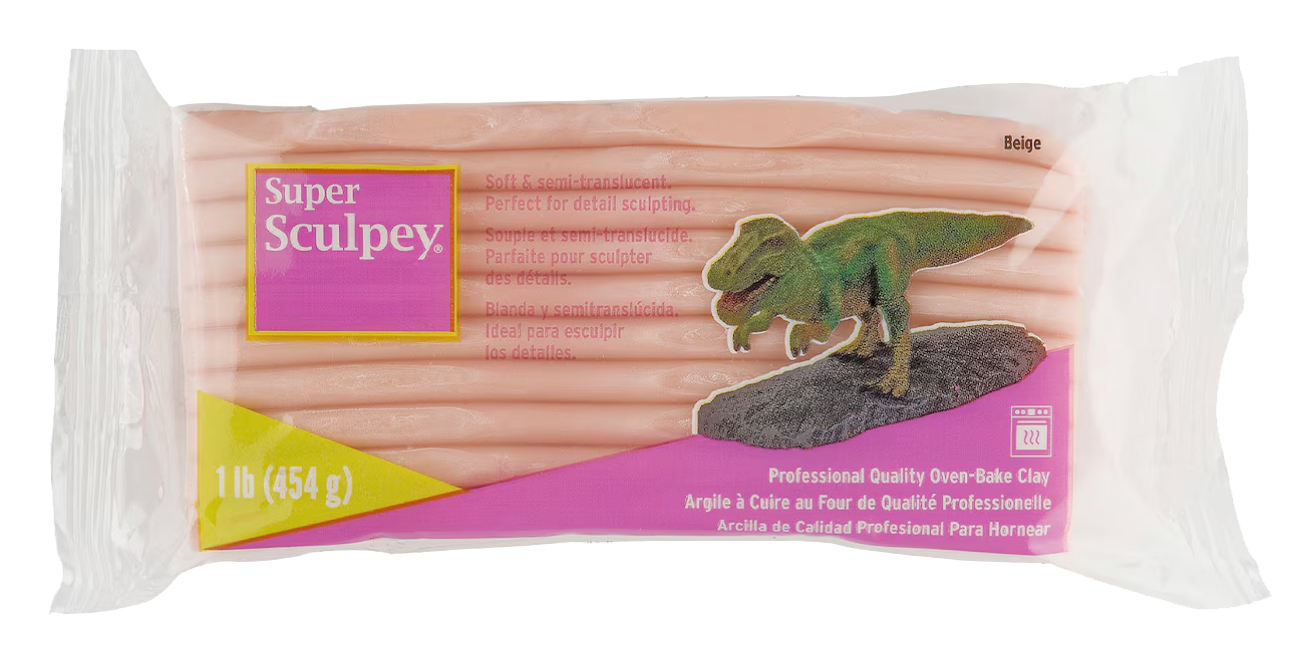
A: I use Super Sculpy. It’s a polymer clay, meaning it’s less like the wet, messy stuff a potter would use and more like a hyper-pliable plastic. It’s clean, waxy, and won’t dry out before baking. It also holds detail incredibly well. I use the beige variant; there are white and grey types too but I prefer the texture of the beige one.
Q: Is Super Sculpy hard to find?
A: Not at all! You can typically find it, along with every other material I use, in art stores like Michaels or Blick.
Q: Okay, so you got your clay. Do you then start by just carving directly into the brick?
A: Just the opposite: I actually start by slicing the brick into thin sheets. I get asked this question a lot, and I get why - for many, the word “sculpture” conjures images of an artist chiseling away at stone or marble! Or, perhaps, a picture of an enormous mound of solid clay to be carved into submission. But with polymer clay, the goal is actually to use the minimum amount possible to complete a piece. This is due to the baking process; the denser the clay, the less likely it is to dry evenly, thus making it more susceptible to cracking in the oven. Hence the sheets. Once I have those, I can start blobbing them on to the armature, which—
Q: Wait…the armature?
A: I guess I should back up a step. Even before the sheet-slicing, I build an armature out of thin-gage wire. Armatures help with proportioning, but more importantly, they are essential for maintaining structural integrity. Super Sculpy is great for its pliability, but by that same token, its weight-bearing capacity is almost zero. A monster without an armature would be a floppy beast indeed. And conveniently, armatures take up mass inside your sculpture that would otherwise be packed with clay. I’ll even build out the armature a little bit with aluminum foil, just to cut down on my clay usage even more. Once the armature is done, then the aforementioned clay-blobbing can commence.
Q: But then what do you do with the armature once the piece is finished?
A: Nothing! It gets baked in. Slice one of these things open, and you’ll find a mess of wire and foil.
Q: Speaking of which, how are you baking these? Are you using a kiln?
A: Nope, just a regular ol’ oven. Same one I use for cookies and turkey dinners (you shouldn’t eat this stuff, but it’s totally non-toxic). You don’t even need to set it to a crazy temperature. In fact, anything above 275 Fahrenheit risks burning the clay. I personally set it to 245, just to be safe. Rule of thumb is you leave it in for 15 minutes per 1/4” of clay thickness, but so long as you’re not exceeding 275 degrees, you can bake Super Sculpy for as long as you want without it burning. I’m rarely baking anything where the clay is more than an inch thick, but again, I err on the side of caution and bake my pieces for about 1-1.5 hours, then keep them in for a bit longer after I’ve turned the oven off so that they cool gradually.
Q: And once it’s cooled, you can’t modify it anymore?
A: Not necessarily. You’d be surprised how much you can alter a piece even after it’s baked. It’s not uncommon for me to put a figure in the oven multiple times before it’s totally done. Especially the smaller pet sculptures: it can be tricky adding texture to those without warping the sculpt, so I often find it easier to bake them in a less-detailed state and then add a thin detail layer on top. Getting the unbaked clay to stick to the baked surfaces can sometimes be annoying, but nothing a little polymer clay adhesive can’t solve. Then I pop the whole thing in again and the new detail layer fuses with the rest of the piece. This technique also comes in handy if I ever need to repair a piece that chips. Just re-sculpt directly onto the figure, re-bake and re-paint.
Q: What sort of paints do you use?
A: I use a brand of acrylics called Folk Art, but any acrylic paint should do the trick. Again, nothing you can’t find at your local art store. I’ll start with a solid base coat of whatever color is going to be most dominant in the piece, then wait for that to dry before adding another coat. Usually by that point the clay is totally covered and I can start in on details, but it’s sometimes hard to tell unless you put the sculpture under a harsh, direct light. A lot of the time that helps expose little pockets where the clay continues to poke through.
Q: And all of your stuff is sculpted by hand?
A: Yes! As of this writing, all pieces on this site are 100% analogue and made personally by me.
Q: Have you ever considered using digital modeling software/3D printing?
A: I have, actually. I don’t think I’d ever shift entirely to digital but I have nothing against either it nor 3D printing. It just doesn’t really fit into my operation right now, for both cost and space reasons. I’m not opposed to incorporating it down the line, though I would want to clearly designate anything printed from all the hand-sculpted stuff.
Q: Would you ever use generative AI to—
A: No.
Q: You don’t know what the question is.
A: The answer is still no.
Q: These are straw-man questions, aren’t they?
A: Yes.
Q: Is the Stay-Puff Marshmallow Man a kaiju?
A: Uh, sure.
Q: How long do these things typically take you to finish?
A: It really depends. The pets - and as you might imagine, I get way more requests for pets than for kaiju! - I can usually turn around in a few days, while a typical monster (about 7” tall, with a base) takes roughly two weeks. That said, since this isn’t my full-time job it often takes a bit longer than that. You know how life is sometimes.
Q: This page is getting kind of long. Anything else you want to add?
A: If any of this has sparked a desire to create your own sculptures - monster-related or no - then go do it! I cannot stress enough how accessible all these materials are. There’s a trove of videos and sites out there that get into the nitty gritty of technique, and by all means seek them out, but the secret to this stuff is that there really is no great secret. The best way to learn is to start and see where you end up.